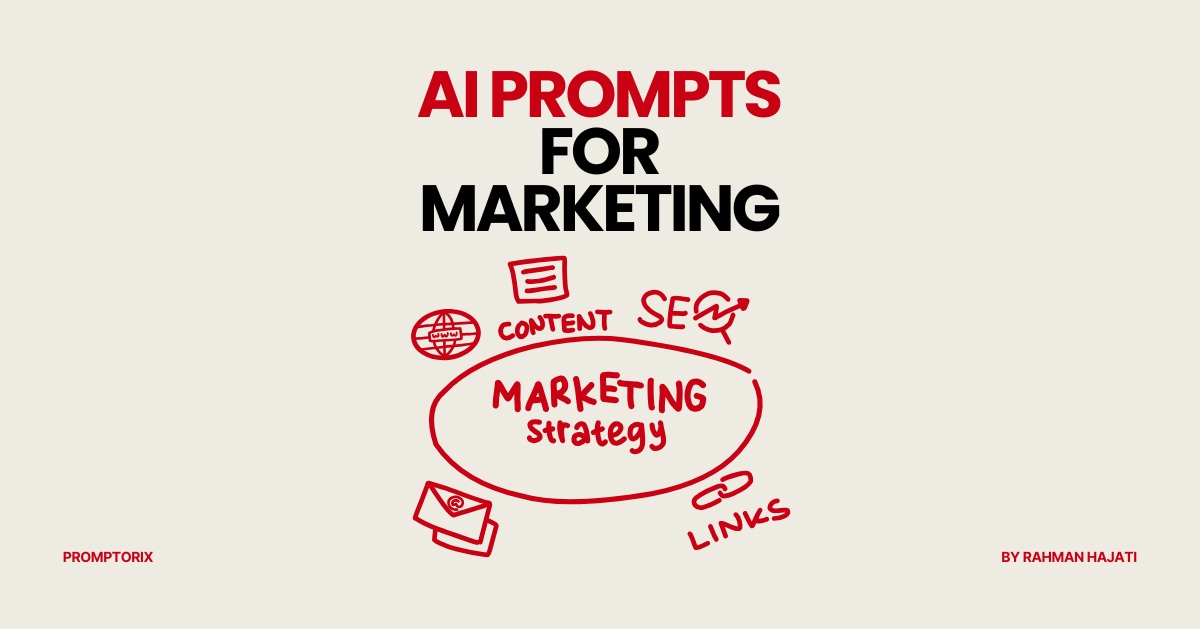
Marketing teams are under more pressure than ever to produce more content, across more channels, faster, and at lower cost. AI has become the obvious answer to that equation. But most marketers are still using it like a search engine — asking broad questions and getting generic output.
The gap between a marketing team that uses AI effectively and one that does not is almost entirely about prompt quality. A vague prompt produces output you have to rewrite. A specific, structured prompt produces output you can actually use.
This guide gives you 40+ copy-paste AI prompts organized across every major marketing function. Each prompt includes the context that makes it work. No filler, no “AI can help you with marketing” padding.
Marketing Strategy Prompts
Prompt 1: Define your ideal customer profile
Act as a B2B marketing strategist.
Build a detailed ideal customer profile (ICP) for a company that sells [product/service]
to [target market].
Include: company size, industry, decision-maker role,
key pain points, buying triggers, objections,
information sources they trust, and how they measure success.
Format as a structured profile I can share with my sales team.
Prompt 2: Positioning statement generator
Write a positioning statement for [brand/product] using this format:
For [target customer] who [has this problem],
[product name] is a [category] that [key benefit].
Unlike [primary competitor], [product name] [key differentiator].

My product: [describe it]
Target customer: [describe them]
Top competitors: [list 2-3]
Core differentiator: [what makes us genuinely different]

Give me 3 positioning statement variations.
Prompt 3: Go-to-market strategy for a new product
Create a 90-day go-to-market strategy outline for [product/service] launching in [market].
Target customer: [ICP description].
Budget: [range].
Team size: [X marketers].
Include:
- Week 1-4: Pre-launch activities
- Week 5-8: Launch activities
- Week 9-12: Post-launch optimization
- 3 primary channels to focus on and why
- 5 KPIs to track
- Biggest risk and mitigation approach
Prompt 4: Competitive messaging analysis
Analyse the marketing messaging of these competitors: [list 3 competitors].
Based on what you know about them, identify:
1. The positioning each is occupying
2. The messaging gaps none of them are addressing
3. The audience segment they are all fighting over
4. One positioning angle I could own that avoids direct competition with all three
Ad Copywriting Prompts
Prompt 5: Facebook/Instagram ad
Write a Facebook/Instagram ad for [product/service].
Target audience: [describe].
Primary pain point: [describe].
Offer: [what we are promoting].

Requirements:
- First 3 words must stop the scroll
- Body: 3-4 short sentences. Pain first, solution second, proof third
- CTA: one clear action
- Tone: [urgent/conversational/aspirational]
- Write 3 variations with different hooks
Prompt 6: Google Search ad copy
Write Google Search ad copy for the keyword "[keyword]."
Create:
- 5 headline options (max 30 characters each)
- 3 description options (max 90 characters each)
- 2 callout extensions

Focus on: search intent match, benefit-led language,
and one specific proof point.
Target: [audience]. Landing page goal: [conversion action].
Prompt 7: Landing page headline and subheadline
Write 5 landing page headline and subheadline combinations for [product/service].
Target: [customer description].
Core benefit: [the one thing we do better than anyone].
Offer on this page: [what they get when they convert].

Format:
Headline (max 10 words)
Subheadline (max 25 words)

Focus on outcome for the customer, not features of the product.
Prompt 8: Long-form sales page section
Write the "Problem" section of a long-form sales page for [product/service].
This section should:
- Open by naming the specific frustration the target customer feels
- Agitate the problem by showing the consequences of not solving it
- Transition to the idea that there is a better way (without revealing the solution yet)
Length: 200-250 words.
Tone: empathetic but direct, not dramatic.
Target customer: [describe].
Content Marketing Prompts
Prompt 9: Content calendar for one month
Create a 4-week content calendar for a [type of brand] in [industry].
Audience: [describe].
Channels: [blog, LinkedIn, Instagram, email — pick what applies].
Themes: [any product launches, events, or seasonal moments this month].

For each piece of content include:
- Topic / angle
- Format (article, carousel, short video, email, etc.)
- Channel
- Primary goal (awareness / engagement / conversion)
- One-line brief on the hook or angle
Prompt 10: Repurpose one piece of content into five formats
Here is a piece of content: [paste article / video transcript / podcast summary].
Repurpose it into:
1. A LinkedIn article (500 words, professional tone)
2. A Twitter/X thread (8 tweets, punchy)
3. An Instagram carousel concept (6 slides with copy for each)
4. An email newsletter section (200 words, friendly)
5. A short-form video script (60 seconds)
Prompt 11: Thought leadership article outline
Create an outline for a thought leadership article on [topic]
for a [job title] audience.
The author's point of view: [describe the unique perspective or contrarian angle].
The article should:
- Challenge a widely-held assumption in the industry
- Provide a framework or model readers can apply
- Include at least one counterintuitive insight
- End with a clear call to think or act differently
Provide H1, H2 structure with one-line descriptions of each section.
Email Marketing Prompts
Prompt 12: Welcome email sequence
Write a 3-email welcome sequence for new subscribers to [brand/newsletter].
What they signed up for: [describe the lead magnet or offer].
Brand tone: [describe].

Email 1 (send immediately): Deliver what they signed up for + set expectations
Email 2 (day 3): Share one high-value insight or story that builds credibility
Email 3 (day 7): Introduce the brand's core offer with a soft CTA

Each email should be under 300 words and feel like it comes from a real person.
Prompt 13: Re-engagement campaign for cold subscribers
Write a 2-email re-engagement campaign for subscribers
who have not opened an email in 90+ days.
Brand: [describe]. Audience: [describe].

Email 1: Acknowledge the silence, give them a reason to stay,
include one strong piece of value
Email 2 (send 5 days later if no open): Last-chance email
— honest, no drama, clear unsubscribe option

Tone: Direct and human, no corporate guilt-tripping.
Prompt 14: Subject line testing batch
Write 10 subject line options for an email about [topic/offer].
Include these variations:
- 2 curiosity-driven (do not reveal the answer)
- 2 direct benefit (what they get)
- 2 numbered/list style
- 2 question-based
- 2 urgency/scarcity (where relevant)
Each under 50 characters. Flag your top 3 picks with a one-line reason.
Social Media Prompts
Prompt 15: High-engagement LinkedIn post
Write a LinkedIn post about [topic] that will generate genuine engagement.
My perspective: [describe your take, especially if it is counterintuitive].
Audience: [who follows me].

Requirements:
- First line must be a standalone hook that works without context
- Use short paragraphs (1-2 sentences max)
- One specific example, story, or data point in the middle
- End with a genuine question or observation (not "what do you think?")
- Under 250 words. No hashtags in the body. 3 relevant hashtags at the end only.
Prompt 16: Instagram caption battery
Write 5 Instagram caption variations for a post about [topic/product/moment].
Brand tone: [describe].
Image content: [describe the image or video].

Variation 1: Short and punchy (under 50 words)
Variation 2: Story-led (100-150 words, conversational)
Variation 3: Educational (list format, practical value)
Variation 4: Question-led (drives comments)
Variation 5: Product/offer focused (clear CTA)

Include 5 relevant hashtags at the end of each.
Brand Voice and Positioning Prompts
Prompt 17: Define brand voice
Define the brand voice for [brand name].
Brand description: [what we do, who we serve].
3 words that describe our ideal tone: [e.g., bold, direct, warm].
3 words that describe what we are NOT: [e.g., corporate, vague, try-hard].

Produce:
1. A brand voice definition (2-3 sentences)
2. A "we are/we are not" table with 5 contrasts
3. 3 writing examples showing the voice applied to different contexts
(a tweet, an email opening, a product description)
Prompt 18: Rewrite for brand voice consistency
Here is our brand voice guide: [paste or describe].
Here is a piece of copy that does not match our voice: [paste copy].
Rewrite it to be fully on-brand.
Then explain the 3 most significant changes you made and why.
Market Research Prompts
Prompt 19: Customer interview question bank
Generate 20 customer interview questions for [brand/product type].
Purpose: understand why customers buy, what they considered before buying,
and what they wish the product did better.

Organize into:
- 5 context questions (who they are, their situation)
- 5 problem awareness questions (before they found us)
- 5 decision questions (how they chose us)
- 5 experience questions (after buying)

Write in plain, conversational language.
No leading questions. Avoid yes/no wherever possible.
Prompt 20: Analyse customer reviews for insights
Here are customer reviews for [product/service]: [paste reviews].
Analyse them to extract:
1. The top 5 reasons customers buy (in their own language)
2. The top 5 frustrations or unmet expectations
3. The specific words and phrases customers use repeatedly
   (to use in copy and ads)
4. Any patterns in who loves it vs who is disappointed
5. One insight that should change how we position or market this product
Campaign Planning Prompts
Prompt 21: Full campaign brief
Write a marketing campaign brief for [campaign name/goal].
Include:
- Campaign objective (specific, measurable)
- Target audience (primary and secondary)
- Core message (one sentence)
- Channel mix and rationale
- Content formats required
- Timeline (4-6 weeks)
- Budget allocation suggestion
- KPIs and how they will be measured
- Success definition at campaign end
Prompt 22: Campaign idea generation
Generate 5 marketing campaign concepts for [brand] targeting [audience]
with the goal of [awareness/leads/retention].
Budget range: [low/medium/high].
For each concept include:
- The big idea in one sentence
- The core hook or tension that makes it interesting
- 3 executions across different channels
- Why this would work for this specific audience
Mistakes Marketers Make with AI Prompts
Not providing customer language
The most powerful marketing copy uses the exact words customers use to describe their own problems. ChatGPT defaults to marketing-speak when it does not have this language. Fix it by pasting actual customer reviews, interview transcripts, or support ticket language into your prompt and telling the model to use that vocabulary.
Using it for strategy without real data
ChatGPT can structure a strategy but it cannot know your actual customer data, your team’s capacity, your competitive positioning, or your historical performance. Treat AI output as a starting framework that you refine with real information, not a ready-to-execute plan.
Not specifying the audience with enough detail
“Write copy for our target customer” tells the model nothing. “Write copy for a 35-45 year old procurement manager at a mid-sized manufacturing firm who is responsible for reducing operational costs and is skeptical of vendors making ROI claims they cannot substantiate” produces copy that actually resonates.
Frequently Asked Questions
Should I use ChatGPT or Claude for marketing copy?
Both are capable. ChatGPT tends to produce punchier, more direct copy. Claude tends to produce more nuanced, carefully reasoned output and is particularly strong for long-form writing that needs to sound genuinely human. Test both on your specific use case — the best choice depends on your brand voice and the task at hand.
Can AI replace a copywriter?
Not for high-stakes, brand-defining work. AI-generated copy lacks genuine cultural insight, emotional intuition, and the creative leaps that make great copywriting memorable. What it can do is handle high-volume, structured copy tasks — product descriptions, ad variations, email subject lines — at a speed and cost that frees skilled copywriters to focus on work that actually requires a human.
How do I stop AI marketing copy from sounding generic?
Three interventions work reliably: provide real customer language from reviews or interviews, give the model a specific voice guide and “sounds like / does not sound like” examples, and iterate with feedback on exactly what is generic about the first output. Generic AI copy is almost always a symptom of a generic prompt.
Related Reading
The prompts above are most effective when combined with a solid understanding of prompting fundamentals. The techniques behind every high-quality prompt on this page are covered in our guide to prompt engineering techniques every AI user should know.
For SEO-specific AI prompts to complement your content marketing strategy, see our SEO prompts for ChatGPT guide.
And for prompts across every marketing function and more, the full ChatGPT prompt library is the reference to bookmark.
For industry-specific prompt guides, see: ChatGPT prompts for sales, ChatGPT prompts for finance, ChatGPT prompts for real estate, and ChatGPT prompts for lawyers.
More prompt libraries for marketers and creators at Promptorix.




Leave a Reply