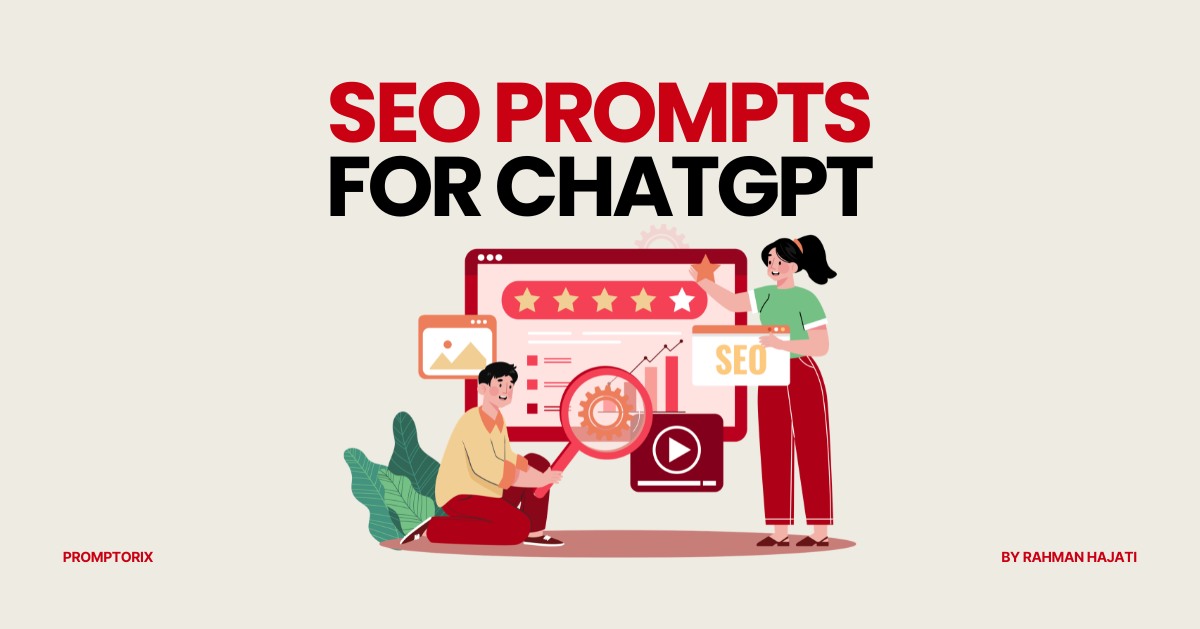
SEO used to take months of painful trial and error. Keyword research, competitor analysis, content briefs, meta tags, internal linking — each piece a separate job requiring separate expertise.
ChatGPT does not replace an SEO strategy. But it compresses the time it takes to execute one by an enormous margin — if you know the right prompts to use.
Most people use ChatGPT for SEO wrong. They ask it to “write an SEO article” and get something generic that will never rank. The prompts that actually move the needle are specific, structured, and used as part of a real process — not a shortcut around having one.
This guide gives you 40+ copy-paste ChatGPT prompts for every stage of SEO, from keyword research to technical audits, all with the context that makes them work.
Keyword Research Prompts
ChatGPT cannot replace Ahrefs or Semrush for volume data. But it is excellent for generating keyword ideas, identifying search intent, and building semantic clusters around a topic you already understand. Use these prompts to expand your keyword universe, then validate the best ones in a proper keyword tool.
Prompt 1: Generate long-tail keyword ideas
Act as an SEO strategist. Generate 20 long-tail keyword ideas
for a [type of website] targeting [audience].
Primary topic: [topic].
Focus on keywords that indicate informational and commercial intent.
Format as a table with columns: keyword, likely intent,
estimated difficulty (low/medium/high), and content format suggestion.
Prompt 2: Identify keyword intent clusters
Take this list of keywords: [paste keyword list].
Group them into intent clusters: informational, commercial, transactional, navigational.
For each cluster, identify the single best piece of content
that could target the entire group.
Find semantic keyword variations: Prompt 3
For an article targeting the keyword "[primary keyword]",
generate:
1. 10 semantic variations Google expects to see in a comprehensive article
2. 5 related entities (brands, tools, people, places) associated with this topic
3. 5 NLP-related terms that increase topical authority
4. 3 question-based keywords suitable for an FAQ section
Prompt 4: Identify content gaps from a SERP
I am trying to outrank the top results for "[keyword]."
Here is what competing articles cover: [paste a brief summary of 3-4 top results].
Identify:
1. What topics, angles, or sections all these articles are missing
2. What unique data, frameworks, or original perspectives could differentiate my article
3. What format changes would improve dwell time and reduce bounce rate
Content Brief and Outline Prompts
A content brief is the most valuable document in your SEO workflow. It defines what a piece of content needs to accomplish before a word is written. ChatGPT builds solid briefs fast.
Prompt 5: Full SEO content brief
Create a full SEO content brief for an article targeting the keyword "[keyword]."
Include:
- Primary keyword and 5 semantic variations
- Search intent analysis
- Target audience description
- Recommended word count range
- H1 suggestion
- H2 structure with a one-line description of each section
- 5 internal link opportunities (I will specify my site's other articles)
- 3 external authority source suggestions
- Featured snippet optimization angle
- People Also Ask questions to address
Prompt 6: Pillar page outline
Create a pillar page outline for the broad topic "[topic]"
on a website about [site niche].
The pillar page should:
- Target the highest-volume head keyword
- Link out to 8-10 cluster articles covering subtopics
- Be structured for featured snippet capture
- Include a comprehensive FAQ section
Provide the full H1, H2, H3 structure with section descriptions.
Topic cluster map: Prompt 7
Build a topic cluster map for a website in the [niche] space.
Pillar topic: [topic].
Generate:
1. The ideal pillar page angle and keyword
2. 8 cluster article ideas that support the pillar
3. The keyword each cluster article should target
4. How each cluster article links back to the pillar
Format as a table.
On-Page SEO Prompts
Prompt 8: Optimize an existing article
Here is an existing article: [paste article or URL summary].
Target keyword: [keyword].
Audit it for on-page SEO and identify:
1. Where the primary keyword is under-used or missing from key locations
(H1, first 100 words, subheadings, image alt text suggestions)
2. Sections that are too thin and need expansion
3. Semantic keywords from this list that are missing: [paste semantic list]
4. Readability improvements that would reduce bounce rate
5. One featured snippet opportunity and how to restructure for it
Prompt 9: Write a keyword-optimized introduction
Write a 150-word introduction for an article targeting "[keyword]."
Requirements:
- Primary keyword in the first 100 words naturally
- Strong hook in the opening line (not a question, not "In today's world")
- Clear signal of what the article delivers
- Conversational but authoritative tone
- No fluff, no filler sentences
Optimize heading structure: Prompt 10
Here are my current H2 and H3 headings for an article on "[keyword]":
[paste headings].
Rewrite them to:
1. Naturally include semantic keyword variations
2. Be phrased for People Also Ask targeting where possible
3. Follow a logical information hierarchy
4. Improve click-through by being more specific and useful
Meta Title and Description Prompts
Meta titles and descriptions are the only two elements that determine whether someone clicks your result. They deserve real attention, and ChatGPT is excellent at generating and testing variations fast.
Prompt 11: Generate meta title options
Generate 8 meta title options for an article targeting "[keyword]."
Requirements:
- Each title under 60 characters
- Primary keyword near the start where possible
- Mix formats: how-to, number-driven, question, direct benefit, contrarian
- Avoid clickbait — must accurately reflect article content
- Flag your top 2 recommendations with reasons
Prompt 12: Generate meta descriptions
Write 5 meta description options for an article about [topic]
targeting "[keyword]."
Requirements:
- Each under 155 characters
- Include the primary keyword naturally
- Include a clear benefit and a soft call to action
- Sound like a human wrote it, not a keyword-stuffed tool
- Vary the hook angle across all 5 options
Competitor Analysis Prompts
Prompt 13: Analyse a competitor’s content strategy
Here is the content from a top-ranking competitor article on "[keyword]":
[paste or summarize content].
Analyse:
1. What they do well structurally
2. What expertise signals they demonstrate
3. Where their content is thin, generic, or missing depth
4. What unique angle I could take to produce a definitively better article
5. Any E-E-A-T signals they have that I should match or exceed
Prompt 14: Reverse-engineer ranking content
Based on these three article summaries ranking for "[keyword]":
[paste summaries].
Tell me:
1. What topics ALL three cover (the baseline I must meet)
2. What only one or two cover (differentiation opportunities)
3. What none of them cover that a genuinely expert article would include
4. The ideal article length and structure based on what is ranking
Internal Linking Prompts
Prompt 15: Build an internal linking plan
I have a new article on "[keyword]."
My site also has articles on these topics: [list 5-10 existing articles].
Identify:
1. Which of my existing articles should link TO this new article (and what anchor text to use)
2. Which articles this new article should link OUT to (and where in the content)
3. Any anchor text variations to avoid over-optimization
Make all anchor text sound natural, not forced.
Prompt 16: Find internal link opportunities in existing content
Here is an article I have already published: [paste article].
Here are other articles on my site: [list titles and topics].
Identify every natural internal link opportunity in the existing article —
where the text could include a link to a related piece,
and what the anchor text should be.
Prioritize links that improve reader experience, not just SEO signals.
Schema and Technical SEO Prompts
Prompt 17: Generate FAQ schema markup
Generate valid JSON-LD FAQ schema markup for these questions and answers:
[paste Q&A pairs].
Format it ready to paste into the head of an HTML page.
Ensure it validates against Google's structured data guidelines.
Prompt 18: Generate Article schema
Generate JSON-LD Article schema markup for the following blog post:
Title: [title]
Author: [author name]
Published: [date]
URL: [URL]
Description: [meta description]
Include all fields Google uses for rich results consideration.
Technical SEO site audit questions: Prompt 19
I am auditing a [type of website] for technical SEO.
Generate a comprehensive technical SEO checklist covering:
crawlability, indexation, Core Web Vitals, mobile-first considerations,
structured data, duplicate content risks, and internal link architecture.
Format as a prioritized checklist with High/Medium/Low impact labels.
FAQ and People Also Ask Prompts
Prompt 20: Generate PAA-optimized FAQ section
Generate 8 FAQ questions and concise answers for an article on "[keyword]."
Requirements:
- Each question should reflect real People Also Ask phrasing
- Each answer should be 40-60 words, optimized for featured snippet selection
- Answers should directly address the question in the first sentence
- Include at least 2 long-tail keyword variations naturally within the answers
Prompt 21: Featured snippet optimization
I want to capture the featured snippet for the query "[keyword]."
The current snippet is: [paste current snippet if known].
Rewrite my answer section to directly compete for this snippet.
Format it as a [definition/list/table/step-by-step] —
choose the format most likely to be pulled based on the query type.
The answer should be between 40-60 words, start with the keyword,
and be structured clearly for machine parsing.
Link Building and Outreach Prompts
Prompt 22: Generate link-worthy content angles
I want to build backlinks to a site about [niche].
Generate 10 content ideas that would naturally attract backlinks from
[target linking domains, e.g., industry blogs, news sites, educational institutions].
For each idea include: the angle, why it attracts links,
and the type of site most likely to link to it.
Prompt 23: Write a link outreach email
Write a cold outreach email requesting a backlink from [type of site]
to my article on "[topic]" at [URL].
My article is better than what they currently link to because: [reason].
Requirements:
- Under 100 words
- No "I hope this finds you well"
- First line references something specific about their site
- Benefit-led, not request-led
- One clear, low-friction ask
Common Mistakes Using ChatGPT for SEO
Using it to write articles from scratch without a brief
“Write me a 2,000-word article about [keyword]” produces content that feels AI-generated, lacks original insight, and will not compete with articles written by people who actually know the topic. ChatGPT should write the parts that benefit from speed and structure — introductions, FAQs, meta tags, outlines — while your expertise and research shape the substance.
Treating keyword suggestions as validated data
ChatGPT does not have access to real-time search volume, keyword difficulty, or SERP data. Every keyword idea it generates needs to be validated in Ahrefs, Semrush, or Google’s own tools before you invest time creating content around it. Use it for ideation, not as a replacement for keyword research tools.
Keyword stuffing the output
If you tell ChatGPT to “include the keyword [X] at least 15 times,” it will do so awkwardly. Google’s NLP systems detect unnatural keyword density, and over-optimization actively hurts rankings. Give the keyword once in the prompt, let it appear naturally, and use semantic variations for everything else.
Not editing for E-E-A-T signals
Experience, Expertise, Authoritativeness, and Trustworthiness are increasingly important ranking signals. ChatGPT cannot provide genuine first-hand experience. You need to add real examples, original data, case studies, and author credentials that no AI can generate. The structure can be AI-assisted; the credibility has to be yours.
Frequently Asked Questions
Can ChatGPT replace an SEO specialist?
No. ChatGPT can dramatically accelerate the execution of an SEO strategy but cannot replace the strategic thinking, competitor analysis using real data, technical auditing, and link building relationships that an experienced SEO specialist provides. Think of it as a skilled assistant that works fast, not a strategist that works independently.
Will Google penalise AI-generated SEO content?
Google’s guidelines focus on content quality and helpfulness, not on how content was produced. AI-generated content that is accurate, original, helpful, and demonstrates genuine expertise will not be penalised. AI-generated content that is thin, repetitive, and clearly produced at scale without editorial oversight is the target of spam policies — as it would be if written by a human.
What is the best ChatGPT model for SEO tasks?
GPT-4 and above with web browsing enabled performs best for SEO tasks that require current information. For structured writing tasks like outlines, briefs, and meta tags, GPT-4 without browsing is sufficient and faster. Claude tends to produce cleaner, less repetitive prose for long-form writing tasks.
What to Read Next
The prompts above work best when you understand the underlying prompting mechanics. The framework that makes every prompt on this page more effective is covered in our guide to Google’s Prompt Engineering course and the TCREI framework.
For prompts covering marketing, writing, coding, social media and more, the complete ChatGPT prompts mega-list is your reference library.
And if SEO is part of a broader marketing effort, see our dedicated AI prompts for marketing guide covering campaigns, copywriting, and brand positioning.
More copy-paste prompt libraries at Promptorix — AI prompts for everything.





Leave a Reply